Haverhill & Methuen, MA — Merrimack Valley
A waterfront city with active revitalization versus a suburban community at the New Hampshire border. Both are genuinely affordable. The differences are real and matter. An honest comparison by a Realtor who works both.

Haverhill vs. Methuen: These two communities compete directly at similar price points. Haverhill's 2024 single-family median was ~$560,000 versus Methuen's ~$590,500. Haverhill has direct MBTA stations and an active waterfront revitalization. Methuen sits at the NH border with easier I-93 car access and proximity to Tuscan Village. School rankings are close: Methuen #114, Haverhill #121 out of 150 in Boston Magazine 2025. Tax rates are nearly identical at around $10.40 to $10.61 per $1,000. The decision is genuinely about lifestyle, not price. Compiled by Lisa Sevajian, Realtor — Lisa Sevajian Group, eXp Realty. Updated May 2026.
When buyers come to me looking at this price range in the Merrimack Valley, Haverhill and Methuen come up in the same conversation more often than any other pairing. The prices are close enough that financial differences do not drive the decision — the lifestyle and community character differences do.
That makes this one of the more genuinely interesting comparisons to work through, because the right answer depends entirely on what your life looks like on an ordinary Wednesday.
Let me walk through both towns as honestly as I can.
| Category | Haverhill | Methuen |
|---|---|---|
| 2024 Median Single-Family Sale | ~$560,000 | ~$590,500 |
| Mar 2026 Median (all types) | $480,500 | $660,000 |
| FY2026 Property Tax Rate | $10.61/$1,000 | $10.40/$1,000 |
| Population | ~67,415 | ~52,812 |
| Median Household Income | $87,675 | ~$83,527–$95,000 |
| Boston Mag School Rank 2025 | #121 of 150 | #114 of 150 |
| MBTA Access | Zone 7 (own stations) | Drive to Lawrence (Zone 6) |
| Owner-Occupied Rate | 61.3% | ~73–75% |
| Choose Haverhill if you want | Choose Methuen if you want |
|---|---|
| Direct MBTA commuter rail access | Faster car access to Boston via I-93 |
| A downtown waterfront and riverwalk | Proximity to New Hampshire for shopping and recreation |
| More city diversity and energy | More suburban residential character |
| Active revitalization upside | Proximity to Tuscan Village and big-box retail |
| Amtrak Downeaster stop | Holy Family Hospital nearby as healthcare anchor |
| The Merrimack River as a defining feature | Greycourt State Park outdoor access |
The Merrimack River bends through Haverhill and the downtown faces it directly. That geographical fact shapes everything about the city — its layout, its character, its history, and its future.
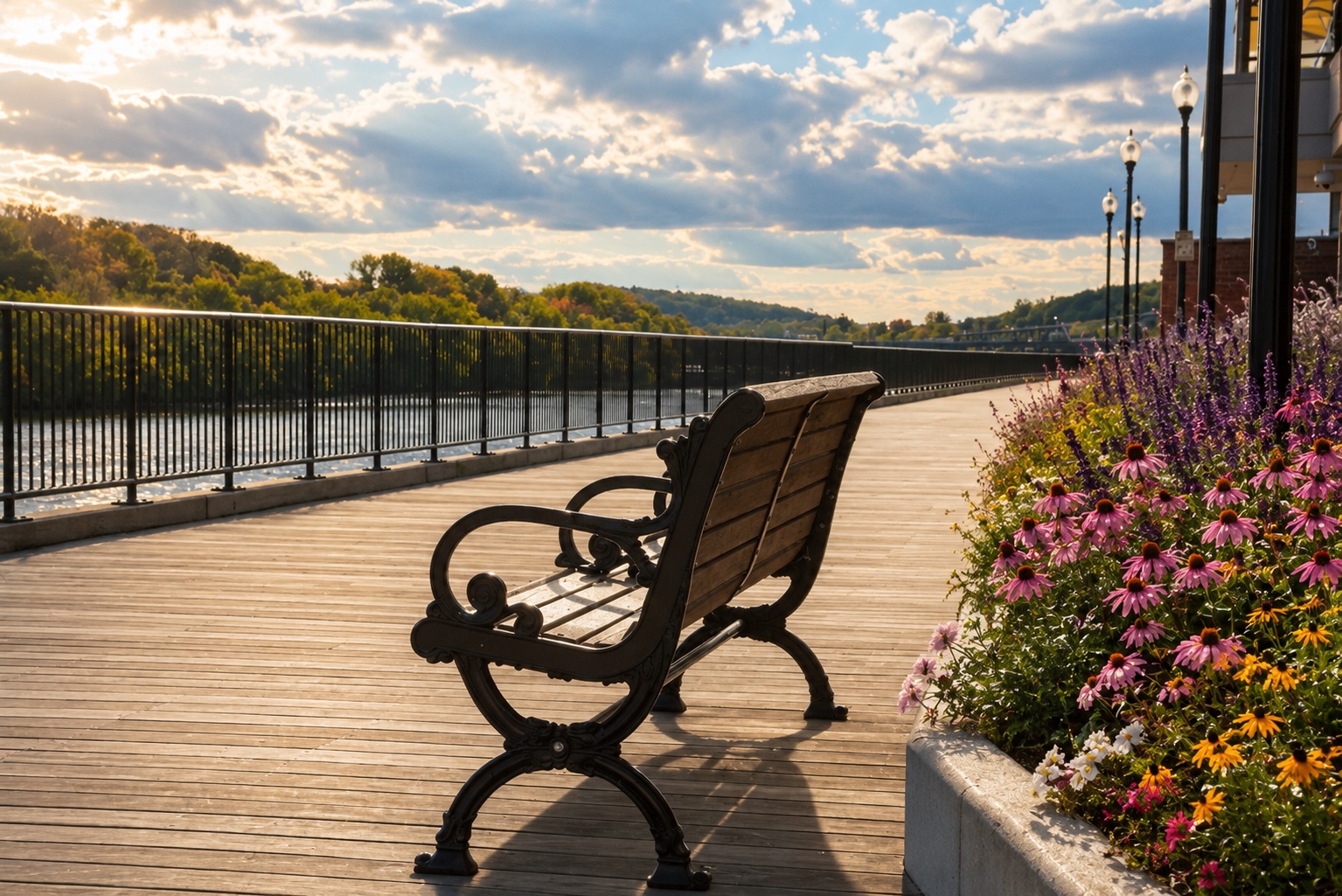
Haverhill was a major 19th-century shoe manufacturing center, and the mill buildings that line the Merrimack Street corridor carry that history visibly. The riverwalk that was developed along the waterfront gives residents and visitors a public promenade along the river that is one of the city's genuine gifts. On a clear day in any season, walking along that waterfront with the old brick buildings on one side and the moving river on the other is genuinely beautiful.
The city is in active revitalization. The $160 million District Square project approved by the city council will bring 370 apartments, a food hall, retail, and public plazas to the Merrimack Street corridor, per Lupoli Companies. The city's Vision Haverhill 2035 master plan positions the downtown and waterfront as central to the city's future, per the City of Haverhill. This is funded and underway.
Haverhill is also one of the more diverse communities in Essex County. Its Latino, Portuguese-speaking, and immigrant-origin communities give the city a multicultural character that shapes everything from the restaurant scene to neighborhood identity. If you want to live in a community with real diversity and real city texture, Haverhill has that.
An average of 6 days before our clients happily accept an offer. See how we get there →
Methuen is more suburban in character. It does not have Haverhill's river, its mill-building downtown, or its active revitalization narrative. What it has instead is practicality, convenience, and a community that has grown steadily on the strength of its location.
Sitting at the Massachusetts-New Hampshire border gives Methuen something Haverhill cannot offer: immediate access to Tuscan Village in Salem, NH — a major mixed-use development with restaurants, retail, hotels, and entertainment that functions as a regional destination. As of March 2026, a new MeVa bus route began connecting downtown Methuen to Tuscan Village and Mass General Brigham, per MeVa Transit's Facebook announcement. That kind of cross-border access has practical value for daily life.
Methuen's residential neighborhoods vary significantly from the more urban dense housing near Lawrence to the more spacious suburban residential areas toward the New Hampshire border. The neighborhoods closest to the NH border tend to have more conventional suburban character — yards, cul-de-sacs, newer construction. Holy Family Hospital provides both an employment anchor and healthcare access within the city.
Methuen is honest about what it is. It is not trying to be a destination. It is trying to be a solid, practical place to live — and for many buyers, that is exactly what they want.
Haverhill's food scene reflects its diverse character. Taqueria Jalisco draws consistent local loyalty for authentic Mexican food. Haverhill Brewery anchors the downtown social scene. Portuguese bakeries and specialty food shops throughout the city reflect its immigrant heritage. As the District Square food hall comes online, a new chapter opens for downtown dining.
Methuen's food scene is also multicultural, shaped by its large Latino and immigrant-origin communities. The Loop at Methuen and proximity to Tuscan Village gives residents access to a broader range of chain and independent dining options than the city's own downtown would suggest. Many Methuen residents treat Tuscan Village and the Salem-Lawrence corridor as their primary dining destination.
Haverhill's outdoor identity is rooted in the Merrimack River. The riverwalk, Winnekenni Castle and grounds, and Plug Pond create a genuine outdoor offering for a city of its size. Nearby Boxford and Georgetown conservation land adds trail access within a short drive.
Methuen's outdoor anchor is Greycourt State Park, which offers hiking and nature access in a wooded setting. The Spicket River Greenway provides a multi-use trail corridor through the city. For residents who want more extensive trail systems, the New Hampshire border is close enough that Rockingham recreation trails are easily accessible.
Weekend rhythms reflect the communities' characters. Haverhill has a more active downtown weekend energy, especially as the revitalization continues. Methuen weekends tend to center more on family activities, Tuscan Village outings, and the natural rhythm of a suburban residential community.
Coffee downtown, walking toward the riverwalk as the Merrimack moves past the mill buildings in morning light. The combination of old brick architecture and flowing water creates a morning atmosphere that Methuen simply cannot replicate — not better, just genuinely different.
A midday hike through Winnekenni Castle grounds, which most people in the region have never visited and which rewards the visit consistently. Afternoon at Haverhill Brewery with the unhurried energy that good neighborhood breweries generate. Dinner somewhere honest in the downtown.
A morning trail walk through Greycourt State Park while the neighborhoods are still quiet. Practical and restorative in the way that accessible suburban open space usually is. A stop for breakfast or coffee somewhere near the town center.
An afternoon drive across the border to Tuscan Village, which functions as a kind of regional town square for the Methuen-Salem NH area — restaurants, retail, things to do with kids, the kind of activity cluster that has become the suburban version of downtown for many families. An evening at home, windows open, dinner on the deck if the weather holds.
Methuen's perfect day is comfortable and functional. That is a virtue, not a limitation.
Methuen High School ranked #114 of 150 in Boston Magazine's 2025 Greater Boston public high school rankings, per Boston Magazine. Haverhill High School ranked #121. Seven positions separate them in a 150-school list — a real but narrow difference.
Both districts serve large, diverse student populations with similar economic profiles. Both have invested in expanding programming and improving MCAS performance. Neither is a top-tier district by current rankings. For families where school quality is the primary driver and budget allows it, North Andover (#60) or Andover (#36) are stronger choices. For families where the Haverhill-Methuen price range is the starting point, the school ranking difference between these two towns is not the deciding factor.
Haverhill's FY2026 rate is $10.61 per $1,000, per the City of Haverhill. Methuen's FY2026 rate is $10.40 per $1,000 under its adopted split-rate classification, per the Methuen FY2026 Classification PDF.
The difference is 21 cents per $1,000 — approximately $117 per year on a $560,000 home. This is not a meaningful tax advantage for either town. The rates are functionally identical and should not be a factor in the Haverhill vs. Methuen decision.
Haverhill has a commuter rail advantage. Haverhill Station and Bradford Station are both within city limits at Zone 7, with typical train travel to North Station around 75 to 85 minutes. By car, Haverhill to Boston runs 55 to 70 minutes via I-495 south and I-93 in normal traffic.
Methuen has no active MBTA station. The nearest is Lawrence Station (Zone 6), approximately 3 miles away on the Haverhill Line, per the MBTA Haverhill Line Wikipedia page. Methuen residents who want commuter rail drive to Lawrence first, adding 10 to 15 minutes each way. By car, Methuen to Boston via I-93 south typically runs 45 to 60 minutes in normal traffic — slightly faster than Haverhill's I-495 route.
Summary: Haverhill is better for rail commuters. Methuen is marginally better for car commuters.
| Population | ~67,415 (ACS 2024) [Census] |
| Median HHI | $87,675 (ACS 5-yr) [Census] |
| BM School Rank 2025 | #121 of 150 [Boston Mag] |
| Tax Rate | $10.61/$1,000 (FY2026) [City of Haverhill] |
| 2024 SF Median Sale | ~$560,000 [Buyers Brokers] |
| Owner-Occupied | 61.3% [Census] |
| Transit | MBTA Haverhill Line Zone 7 — Haverhill & Bradford Stations [MBTA] |
| Population | ~52,812 (2024 est.) [Methuen Housing Plan] |
| Median HHI | ~$83,527–$95,000 (ACS est.) [Methuen Housing Plan] |
| BM School Rank 2025 | #114 of 150 [Boston Mag] |
| Tax Rate | $10.40/$1,000 (FY2026) [Methuen Classification PDF] |
| 2024 SF Median Sale | ~$590,500 [Buyers Brokers] |
| Owner-Occupied | ~73–75% [Methuen Housing Plan] |
| Transit | No MBTA station; nearest is Lawrence (~3 mi), Zone 6. MeVa Routes 6, 25, 26, 28 [MBTA] |
The gap is narrow. Haverhill's 2024 single-family median was ~$560,000. Methuen's was ~$590,500. Historically Haverhill has been the more affordable of the two, and in single-family homes it still holds that position. Both are accessible compared to Andover or North Andover.
Haverhill, clearly. It has two MBTA Haverhill Line stations at Zone 7 within city limits. Methuen has no active MBTA station. Methuen residents who want commuter rail drive to Lawrence Station (~3 miles away) and board there, adding 10 to 15 minutes each way.
Methuen High ranked #114 and Haverhill High ranked #121 out of 150 in Boston Magazine's 2025 Greater Boston rankings. Seven positions separate them. Neither is a top-ranked district. The difference is real but narrow.
Haverhill FY2026: $10.61 per $1,000. Methuen FY2026: $10.40 per $1,000. The difference is 21 cents per thousand — functionally identical and not a meaningful factor in choosing between them.
A mid-size suburban city at the Massachusetts-New Hampshire border, with convenient I-93 access, proximity to Tuscan Village in Salem NH, Holy Family Hospital as a major employer, and neighborhoods ranging from more urban near Lawrence to more suburban toward the NH border.
Yes. Tuscan Village in neighboring Salem NH is minutes from Methuen and functions as a regional destination with restaurants, retail, and entertainment. The Loop at Methuen provides major big-box retail within the city. A new MeVa bus route as of March 2026 connects Methuen to Tuscan Village and Mass General Brigham.
The Merrimack River and its downtown waterfront. The riverwalk, the mill buildings, the river's bend through the city — these create a sense of place that Methuen simply does not have. It is a different kind of urban experience at a similar price.
Methuen. It shares a direct border with Salem, NH. Buyers who want quick NH access for shopping, Tuscan Village, or recreation will find Methuen more convenient. Haverhill does not share a NH border.
Greycourt State Park for hiking and mountain biking. The Spicket River Greenway for multi-use trail access. And easy proximity to NH outdoor recreation. Not as distinctive as Haverhill's river-and-riverwalk combination, but genuinely accessible.
Haverhill to Boston by car: 55 to 70 minutes in normal traffic via I-495 south. Methuen to Boston by car: 45 to 60 minutes via I-93 south. Methuen has a slight car-commute advantage. Both extend significantly in peak hours.
Yes, particularly for buyers who want suburban residential character, NH border access, and convenient I-93 car commuting. Haverhill is equally valid for first-time buyers who prefer city energy, commuter rail, and waterfront access. The right choice depends on your life, not your ZIP code.
Haverhill arguably has more identified upside given the $160 million District Square revitalization and Vision Haverhill 2035 plans. Methuen's growth has been steadier and more suburban. Neither is certain. Buy for the life you want today.
Both have diverse multicultural food scenes reflecting their populations. Haverhill has more downtown destination dining. Methuen residents lean on Tuscan Village and the Lawrence-area dining corridor as much as in-city options.
Call or text Lisa Sevajian at 978-457-3406. I work both markets and can walk you through specific neighborhoods, current inventory, and what your budget realistically buys in each town right now — not in the aggregate data, but in the actual properties available.
Written by Lisa Sevajian, a licensed Massachusetts and New Hampshire Realtor with over 20 years of direct experience. All pricing reflects general market conditions as of spring 2026 and is not a guarantee of any specific property value.
I work both markets and can help you understand what your budget actually buys in each one today. Tell me what your life needs.