Schools or the house? How North of Boston parents make the trade-off without regret.
Family buyers in Northern Massachusetts and Southern New Hampshire rarely get the top-ranked district and the right house at the same price. This guide lays out the real trade-off: daily life, the full cost of ownership, and whether the school plan still works if life changes.
By Lisa Sevajian · Top 1.5% of over 1,400,000 Realtors in the US Published September 24, 2026 · 12 min read
Quick Answer
There is no universally right answer. The better question is which ongoing cost a family can carry for the next 10 to 12 years without resenting it. Compare three things side by side before making an offer: how each option feels on an ordinary school morning, the full monthly cost beyond the mortgage, and whether the school plan still works if a child's needs change.
The Short Version
Neither choice is free. Choosing the district often means less house or a tighter payment. Choosing the house often means more school logistics.
Price gaps between towns are large. In 2026 year-to-date sales, the average price in Andover ran roughly twice the average in Haverhill.
Ratings are a starting point. A highly ranked district can still be the wrong fit for a particular child.
Confirm the assigned school for the exact address before buying. Living in a town does not guarantee a specific school.
Price the Plan B. School choice seats, charter lotteries, and private tuition all vary and can change year to year.
The trade-off every family eventually faces
Two children. Years of school ahead. One house the family loves, in a district they had not planned to consider. That is the real question behind many family home searches north of Boston. The question is rarely "Which town has the best schools?" or "How much house can we get?"
The harder question is this: which cost can the family live with for the next 10 to 12 years without resenting it?
Lisa Sevajian has made this decision twice herself: once when her children were younger, and again when they were older. She struggled both times. Market knowledge did not make it easier. When it is your own children, your own budget, and your own kitchen table, no spreadsheet makes the trade-off painless. What she learned is that every answer has a cost. The families who feel most at peace later are not always the ones with the biggest house or the highest-rated district. They are the ones who saw the cost clearly before they committed.
This is Part 1 of 4 · Schools, House, and Real-Life Cost
Picture an ordinary Tuesday at 7:30 a.m. Not a sunny Sunday open house. A regular school morning when everyone is running late, it is raining, and someone cannot find a shoe.
Choosing the district first may mean a shorter school run and more confidence in the public school option. The house may also be smaller than hoped, need updating, or come with a payment that leaves less room for activities, repairs, savings, and travel.
Choosing the house first may mean the space, layout, and budget flexibility the family needs. School logistics may become part of the weekly load: a longer drive, aftercare puzzles, transportation costs, or private tuition.
Neither Tuesday is free. The goal is to understand which ongoing cost the family can realistically carry.
A quick gut check
Finish two sentences honestly, then ask a partner to do the same separately. "We could live with less house if it meant ______." "We could live with more school logistics if it meant ______." Many couples discover they are not disagreeing about a town at all. One is protecting financial breathing room. The other is protecting certainty for a child.
What the same decision costs in five towns
Price differences between neighboring communities north of Boston are significant. The chart below shows 2026 year-to-date average sale prices in five towns the team works in every week.
2026 YTD average sale price
Andover's average sale price runs about twice Haverhill's.
Haverhill
$641,764
Amesbury
$726,990
North Andover
$1,025,285
Newburyport
$1,178,235
Andover
$1,318,510
Source: MLS closed sales, January 1 through August 21, 2026, compiled by the Lisa Sevajian Group. Averages include all property types and are not appraisals.
Town
Avg. sale price
Avg. $/sq ft
Closed sales
Haverhill
$641,764
$340.74
215
Amesbury
$726,990
$392.03
82
North Andover
$1,025,285
$378.10
101
Newburyport
$1,178,235
$575.29
69
Andover
$1,318,510
$423.03
151
Price per square foot tells a second story. North Andover's average price is far higher than Amesbury's, while its price per square foot is slightly lower, which usually means larger homes rather than more expensive space. Newburyport buyers pay the most for each square foot by a wide margin. Averages hide a lot, which is why the comparison should always come down to specific homes.
Top-ranked schools, very different town costs
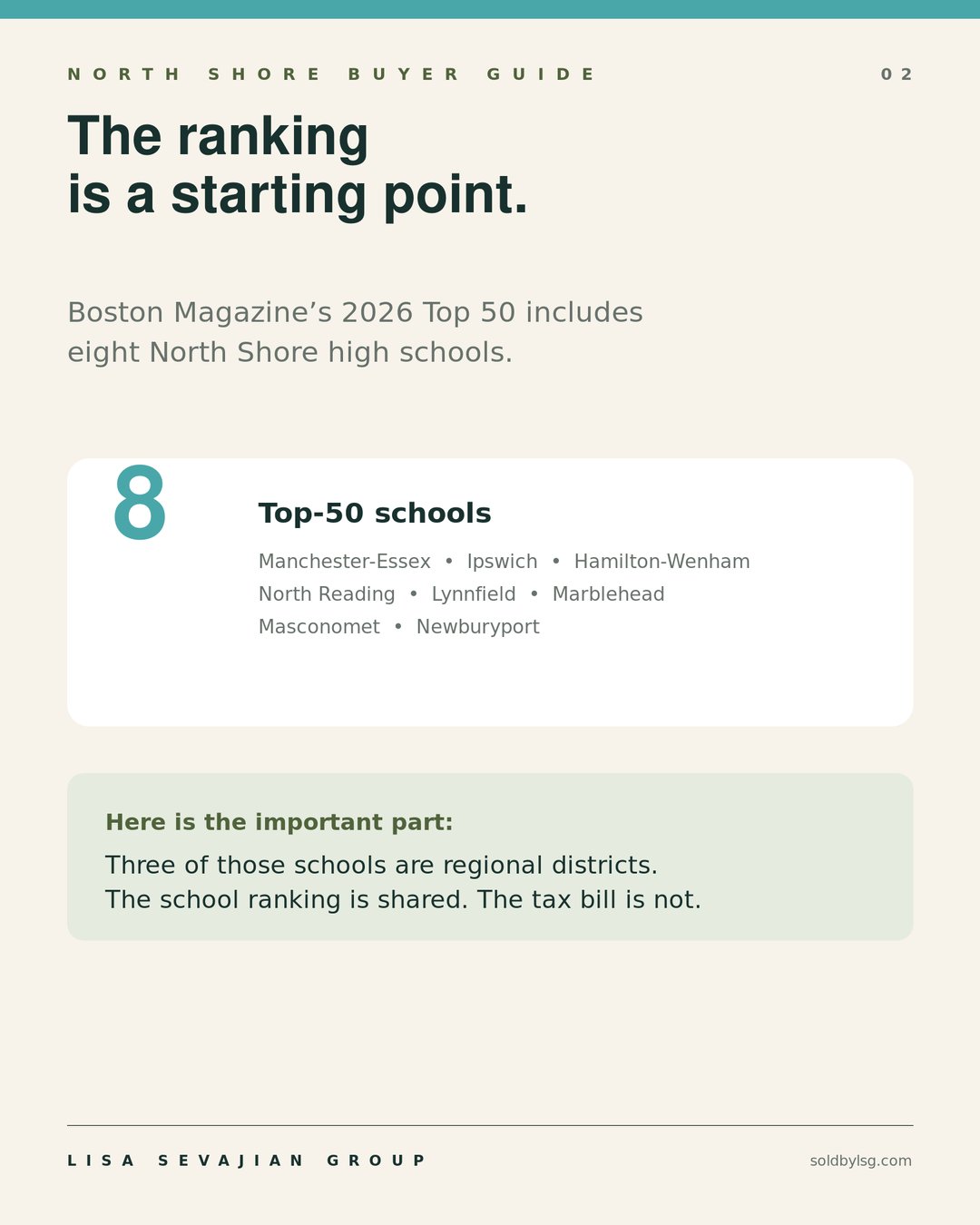
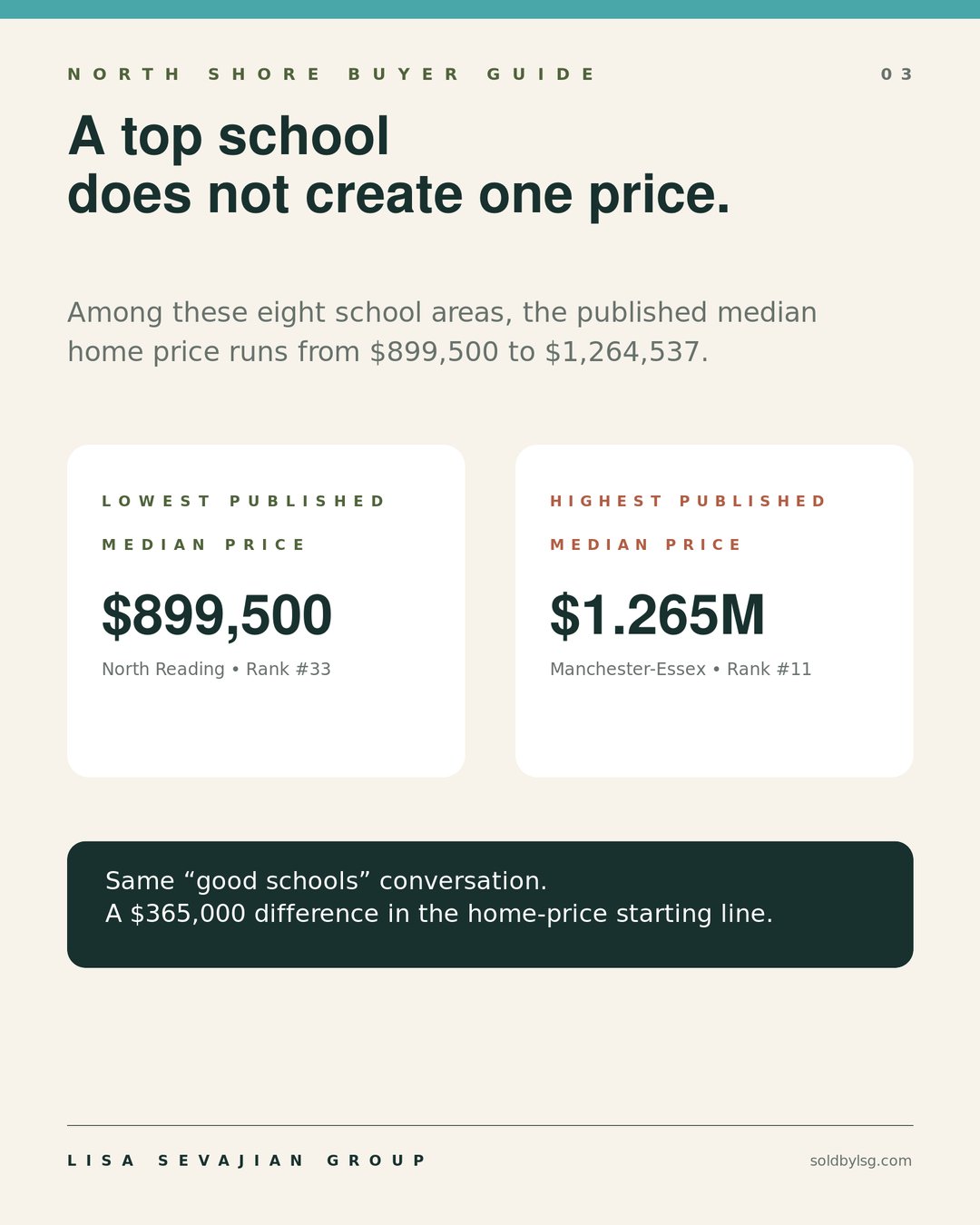
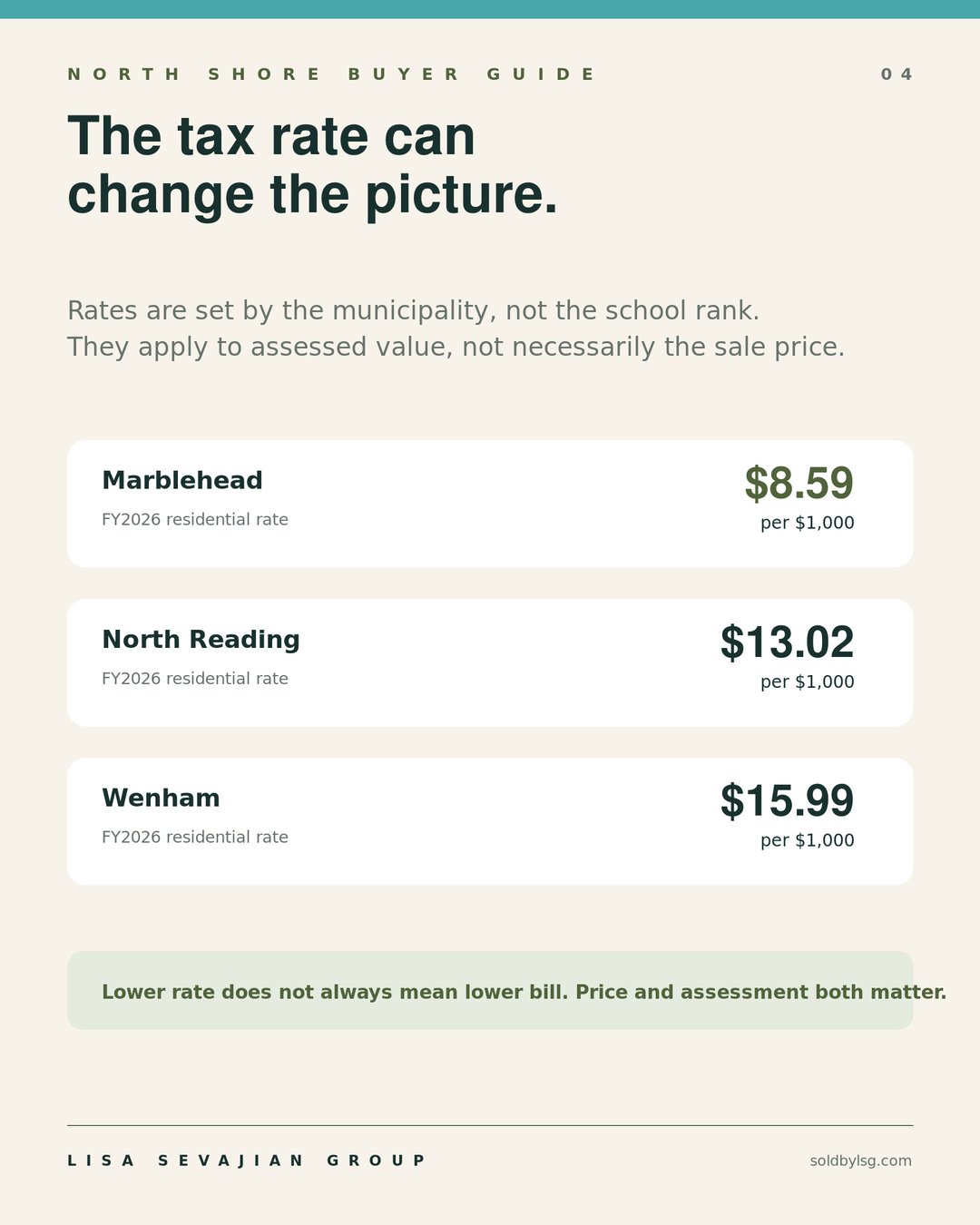
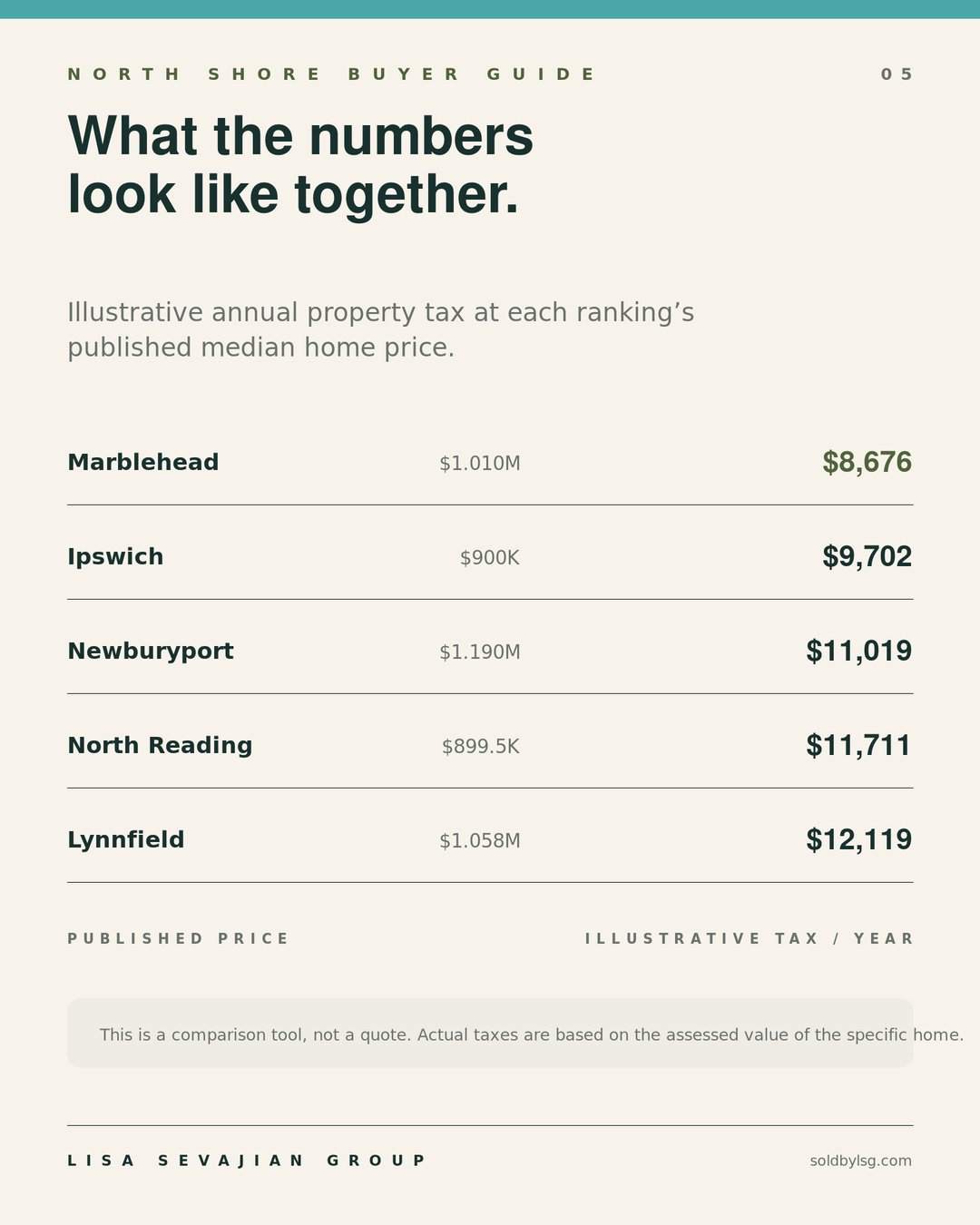
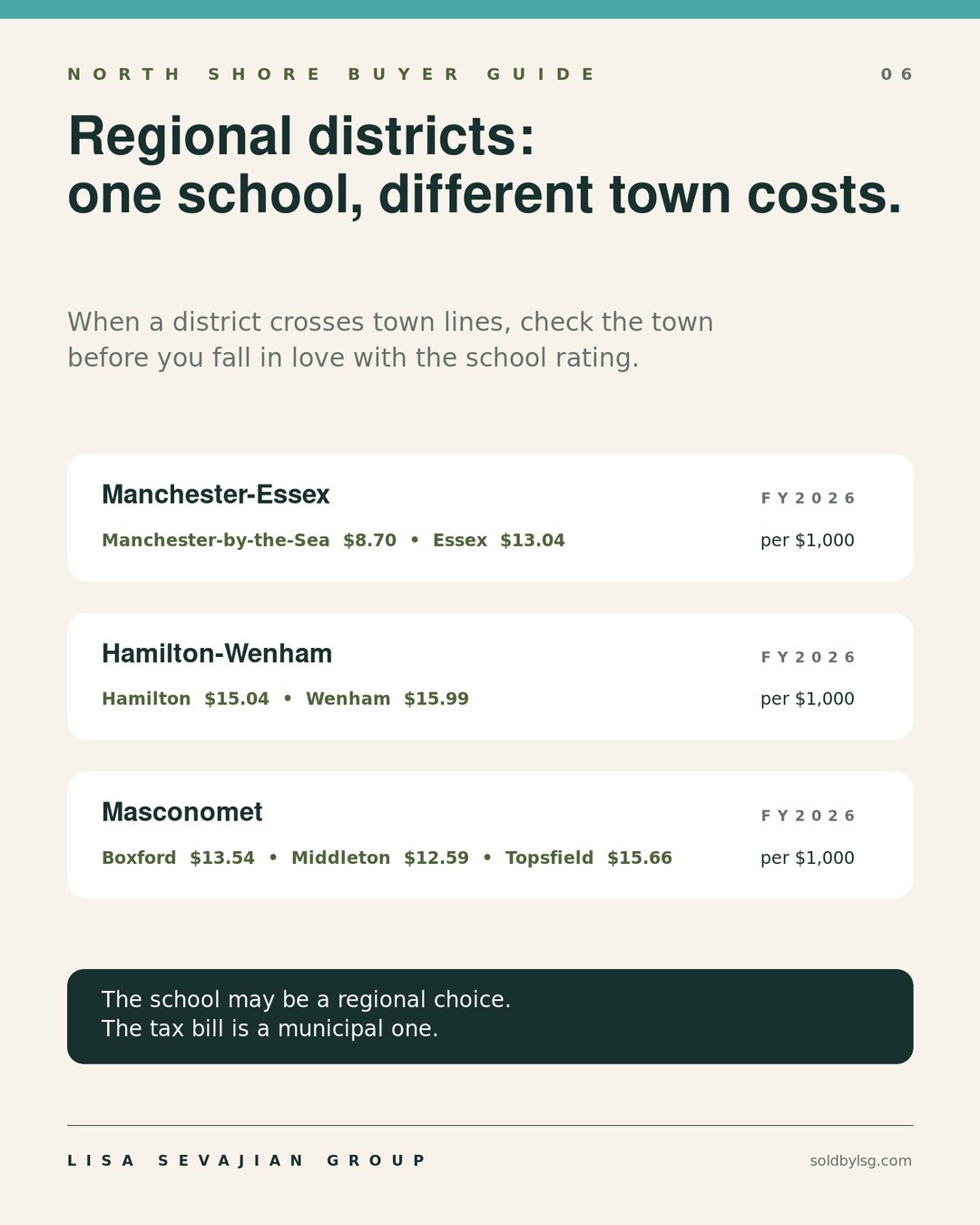
Boston Magazine's 2026 ranking includes eight North Shore high schools in its Top 50. The published median home price across those school areas runs from $899,500 to $1,264,537, and FY2026 residential tax rates range from $8.59 in Marblehead to $15.99 in Wenham. Three of the eight are regional districts, which means one shared school can come with very different town costs depending on which side of a town line the house sits. Swipe through the eight slides below.
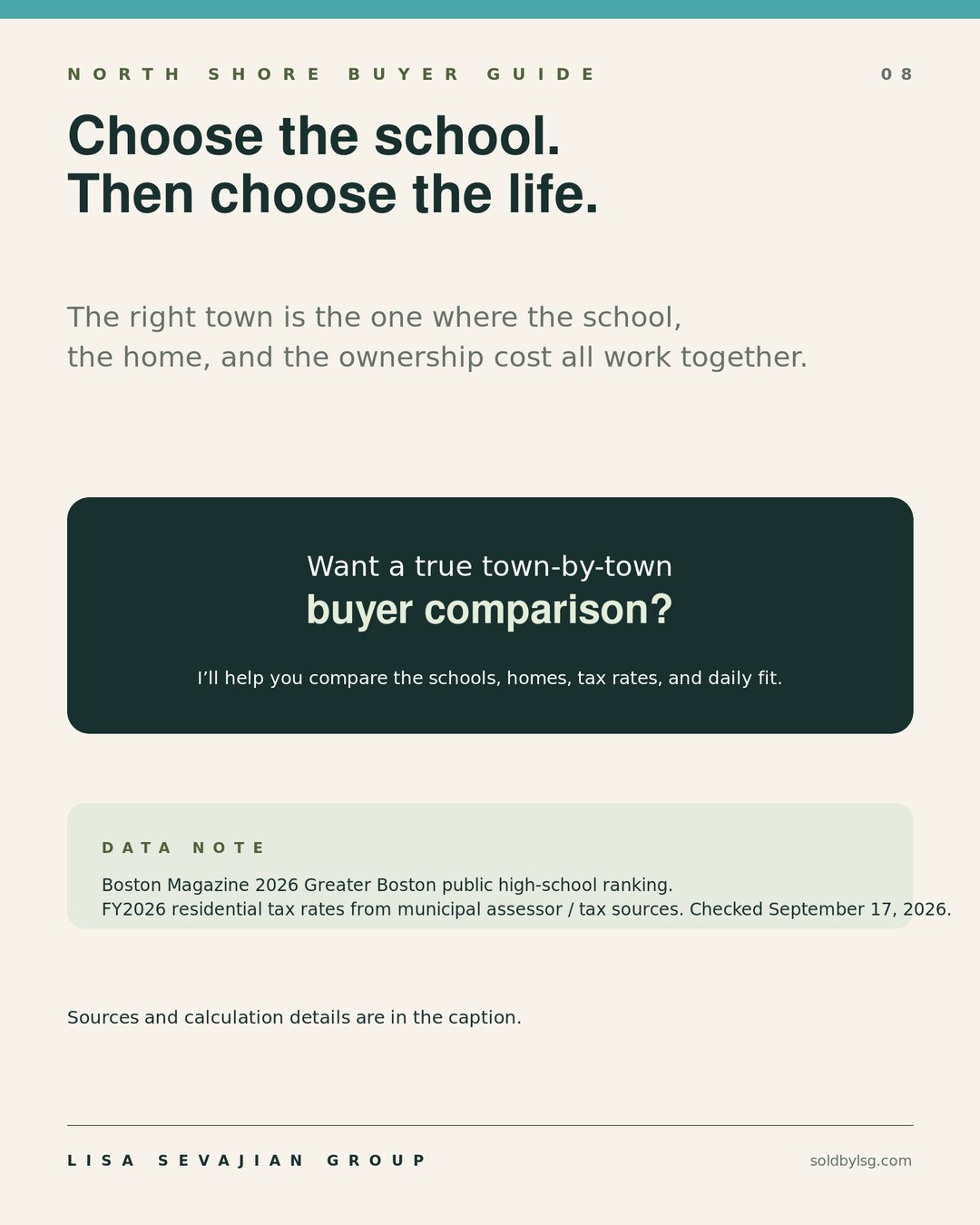
Home prices are the median values published in Boston Magazine's 2026 Greater Boston high school ranking, not average sale prices. Illustrative taxes multiply that median by each town's FY2026 residential rate; actual bills are based on assessed value. Rates checked September 17, 2026.
Compare the three things that matter
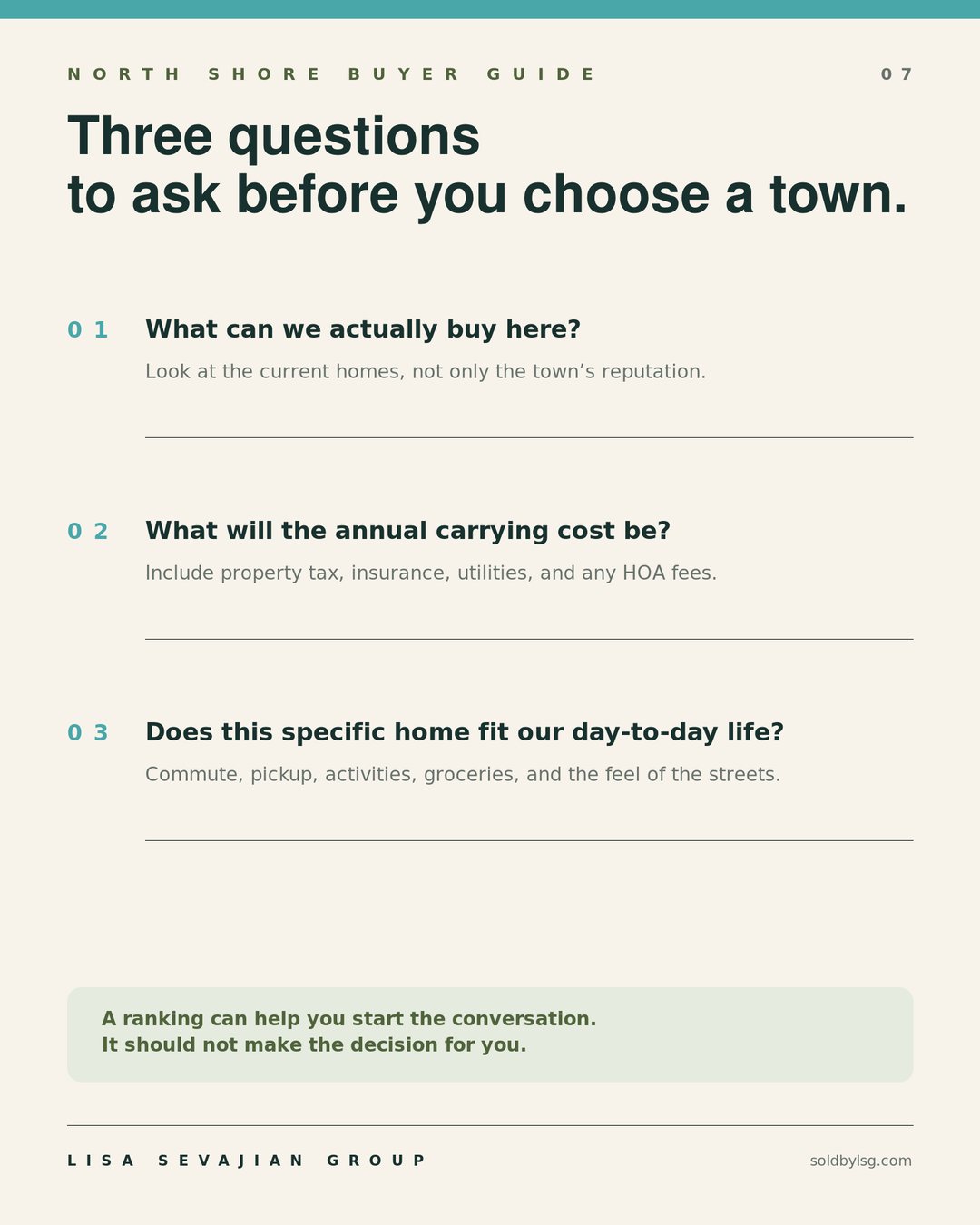
Most buyers start with a school rating and a list price. Those are inputs, not answers. A better decision compares daily life, the full financial picture, and school fit plus flexibility.
1. Daily life: how will this choice feel every week?
How long is the drive to school at the actual drop-off time?
How long is the work commute in the direction it will really be driven?
Can the household handle pickup, aftercare, activities, and early-release days?
Does the home have the bedrooms, storage, outdoor space, and layout the family needs now?
Drive the route at the hour it will be used. A "15-minute drive" means something very different during a January storm or at afternoon pickup.
2. Financial reality: what does the whole decision cost?
The purchase price is only one part of the cost. Compare the full monthly and annual picture: principal and interest, property taxes, insurance, utilities, immediate repairs, transportation, before- and after-school care, school fees, and any private or alternative school cost that is part of a realistic backup plan.
A lender can confirm whether a family qualifies for a payment. That does not show whether the payment leaves room for a normal life. Compare housing costs against take-home pay, not only against the maximum approval.
3. School fit and flexibility: what happens if things change?
A highly rated district can still be the wrong fit for a particular child. A district with a less impressive online reputation may offer the teacher relationships, programs, or schedule that work well for a family. Start with official data, then go further:
Which school would the child actually be assigned to at this address?
Are assignments address-based, lottery-based, or subject to capacity?
How stable are staffing, leadership, and district finances?
What does the middle school transition look like?
How does the district support students with IEPs or changing needs?
What is the real Plan B if the school is not a fit in two or five years?
Send Lisa the two towns or two homes being compared, and the trade-off that is keeping the decision stuck. Book a time to compare them →
The questions buyers miss
School assignment and transportation. Living in a town does not guarantee a specific school. Call the district office before buying and ask which school the address is assigned to, whether that assignment is guaranteed, and how bus eligibility, fees, and aftercare availability work.
Leadership, budget, and program stability. A school profile shows history. It may not show staff reductions, program changes, or leadership turnover now under discussion. School committee minutes, district budgets, and conversations with current parents fill that gap.
The middle school transition. Many families love elementary school and are surprised by the move to middle school. Parents with older children are the best source on schedules, supports, and culture after fifth grade.
The actual backup plan. In Massachusetts, inter-district school choice depends on the receiving district and can change year to year. In New Hampshire, program options and eligibility vary by location. Charter lotteries, private tuition, and transportation all vary widely. A Plan B may be workable. It may also involve a lottery, a long drive, or tuition the family cannot sustain. It is far better to know that before the offer.
Which family is this?
The district-first family is willing to trade size, finishes, or budget flexibility for confidence in the public school option.
The house-first family needs a home that supports daily life and a school plan that works, not necessarily the highest number on a ranking site.
The flexibility-first family wants enough financial and logistical margin to adjust if a child's needs change, and weighs every alternative before stretching for a house.
The still-deciding family knows schools matter but has not yet defined what matters most. That is normal, and it is the best time to do this work.
How the Lisa Sevajian Group helps
The team does not tell families which town, school, or house is right. The work is helping them see the decision clearly enough to own it: comparing homes that fit daily needs, the full cost of each option, commute and aftercare logistics, the questions to verify with each district, and the flexibility that remains if something changes later.
If a family chooses the district, the team finds the best home within that decision. If a family chooses the house, the team makes sure the school plan is real rather than assumed. If a family wants both, the conversation gets honest about what may need to give and where balance is still possible.
The honest bottom line
Before choosing a town, compare the trade-off
Compare the full life attached to each home, not only list prices and school ratings.
Run the Tuesday-morning test on every finalist.
Price the whole month: taxes, commute, care, and any backup school cost.
Confirm the assigned school for the exact address in writing.
Know the real Plan B, and what it costs, before making an offer.
Frequently Asked Questions
Should we buy in a higher-rated district if we do not love the house?
Possibly, as long as the home works for real daily needs and the payment leaves enough margin to live comfortably. A school district cannot fix a house that makes daily family life harder than it needs to be.
Should we prioritize the house over the schools?
Possibly, as long as the school assignment, daily logistics, and realistic alternatives have been verified. Choosing the house can be a very good decision. The mistake is assuming the school plan can be solved later without knowing its cost or availability.
Is the highest-rated school always the best school for our child?
No. Ratings summarize selected data points. They do not show whether a school's culture, supports, or programs fit a specific child. Use data as a starting point, then visit, ask questions, and talk with current families.
How do we know which school our child would attend?
Ask the district directly about the exact address before buying. Confirm the assigned school, whether capacity could affect it, whether transportation is provided, and any enrollment steps required.
Can we change schools later if it does not work out?
It depends on the district, available seats, enrollment rules, and transportation. Do not assume a later switch will be easy. Research every realistic option, including cost, before the purchase.
What should we compare besides the mortgage payment?
Property taxes, insurance, utilities, repairs, commute costs, before- and after-school care, school fees, and any alternative school cost. The goal is the total monthly and annual cost, not simply whether the purchase price qualifies.
Sources & Important Information
This article reflects real estate experience and general decision-planning guidance. It is not educational, financial, tax, or legal advice. School assignments, enrollment policies, transportation, programs, and tuition change; verify current information directly with the relevant district, school, lender, and attorney before a purchase.
Share the two towns or homes on the list and the trade-off that is hardest to make. The team will help identify the questions worth answering before moving forward.
Founder, Lisa Sevajian Group · eXp Realty · Agents licensed in MA & NH
Lisa Sevajian has guided nearly 2,000 sales across Northern Massachusetts and Southern New Hampshire, and her team ranks in the Top 1.5% of over 1,400,000 Realtors in the US. She has made the schools-versus-house decision herself more than once, and works with families who want to honor both priorities without pretending the choice is simple.